Why am I in survival mode?
Even though we often don’t want to, we do it anyway: we go into survival mode. Why does this mode often kick in when we experience trauma or old pain? Because we have a survival system. A what?
“The survival system consists of all the mechanisms that enable us to survive quickly and are particularly triggered by the memory of danger.”
And we all face danger. Whether it’s an accident, being bullied at school or work, or whether it involves insecure attachment, a sudden death, or abuse: our survival system wants to get us to safety in a flash when things don’t feel safe. And: it’s really good at it.
Of course, there’s nothing wrong with that… if there’s a real threat or danger and if we ourselves aren’t yet able to act wisely from our Holy Grail, our true self. Then a survival system is incredibly helpful. But… how often is that really necessary? The system doesn’t know. Only you can discover that. How? I’ll show you in a moment, but first, let’s talk about that survival system. What is it, really?
THE SURVIVAL SYSTEM
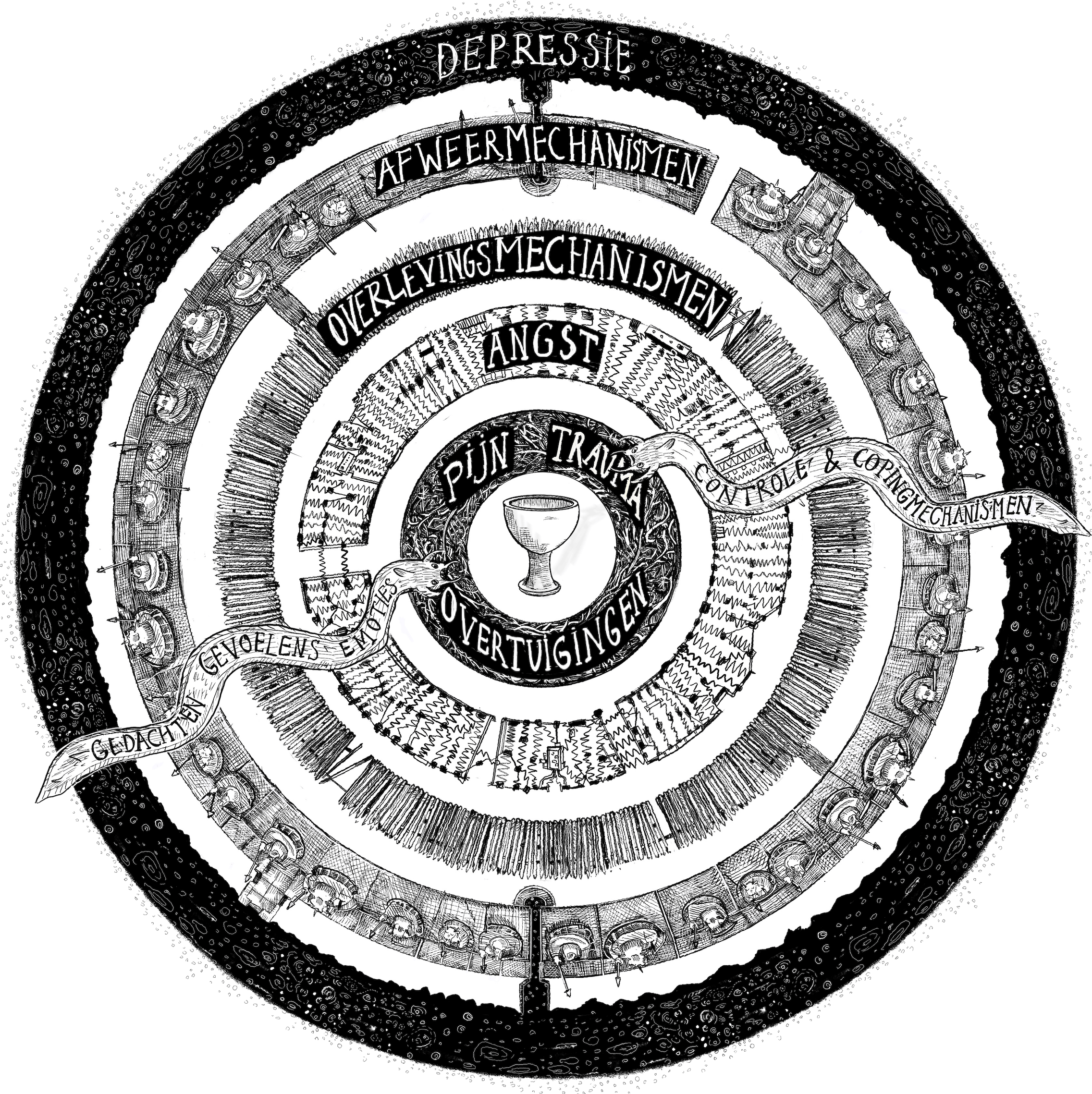
What are the layers of the survival system?
- Your Holy Grail is in the center
- Underlying all of this is a foundation of pain, trauma, and beliefs
- That is where fear lies
- And then your coping mechanisms
- Your defense mechanisms
- And finally, depression
- Your unhealthy thoughts, emotions, and feelings—as well as your coping mechanisms—are still running through your system
Take a look at the illustration accompanying this article. It’s from the book *Discover Your Holy Grail*. At the center of the survival system (SS) lies your Holy Grail. This means that there is always a wise and healthy part of you that you can tap into, no matter how difficult life gets.
A sudden or prolonged sense of insecurity (often during childhood), combined with an inability to process it in the moment, gives rise to pain, trauma, and beliefs: the breeding ground for your OS. These cover up your spontaneous, true self. Because this ground is so painful, uncomfortable, or frightening, we try to avoid those feelings and create a survival system designed primarily to keep us away from the memory of our old pain and insecurity. Sometimes unconsciously, such as fears designed to ensure we don’t have the same experience again. Sometimes impulsively, such as our survival mechanismsfight, flight, flattery, or freeze. Sometimes largely unconsciously, such as our defense mechanisms and coping mechanisms. You use defense mechanisms to ward off pain. Coping mechanisms are meant to avoid pain by controlling life.
WE THINK IT’S US
Eventually, we become so entangled with our survival mode and the survival system we set up in childhood that, as adults, we continue to live by these patterns and even come to believe that this is simply who we are. We please others, work hard, judge others, or avoid difficult conversations. All the while, we’re actually in a constant battle to avoid pain, suppress trauma, and deal with our beliefs. And that takes an enormous amount of energy. It can even lead to depression.
On top of all these layers, there are also grinding and swirling thoughts, feelings, and emotions that often take you from bad to worse, yet still give you a sense of control and familiarity, making it impossible to let them go.
SURVIVAL
If you’re reading this, you might be thinking, “But a system like that doesn’t sound very appealing.” I’ve thought that myself many times. And then I wanted to get rid of it. And yet we have it… for as long as it’s needed. As long as you’re still carrying around unprocessed pain, fears, or beliefs. As long as you don’t yet know how wise you are. The survival system is the system of a powerless child. A child within you who—through you—wants to be heard and seen. Comforted and embraced. Who wants to hear from you:“You are safe. I acknowledge you. I see your pain.” If you can do this more and more without judgment, you’ll notice that from your true adult self, you can care for those parts of you that find life scary, painful, or unsafe. And that they’ll ask you for help more and more often, rather than impulsively following the system.
You reveal your true self layer by layer, by recognizing the survival mechanism in your daily life, peeling it away bit by bit, and letting it go wherever possible. Who emerges then? You! You Holy Grail becomes a little more visible with every action, and I am certain: that is a treasure that deserves to be revealed to everyone—first and foremost to yourself.
You can read about how to do this in *Discover Your Holy Grail*. You can also listen to our podcast or sign up for one of our events, where you can learn, together with others, to dismantle your survival system step by step, allowing you to spend less and less time in survival mode and, in doing so, learn to heal yourself.
I’m Rianne van Kuil, author of Discover Your Holy Grail – Your Journey from Trauma to Healing
, trauma and experiential expert, and podcast creator. I believe that complete healing from trauma is possible and guide people on that journey.
Other articles
Even though we often don’t want to, we do it anyway: we go into survival mode.

→ Do your thoughts sometimes run away with you? → Do you want more peace of

→ Do you want to feel, but don’t know how? → Are you feeling all sorts

