Why do I have a tendency to please others?

We’d only been dating for a few months, and recently I’d started staying over at his place every now and then. Of course, I’d pitch in with small household chores like loading the dishwasher.
I quickly learned that my partner arranged things in a certain way, using a keen eye and a well-developed sense of spatial awareness. I lack a keen eye and certainly have no sense of spatial awareness, but I did my best. I really did my best.
And that… didn’t go well. According to my dear Siem, putting things away could be done a lot more efficiently. When he told me that, I lost my temper: I was already doing my best, and this still wasn’t good enough? What nonsense!
What is people-pleasing behavior?
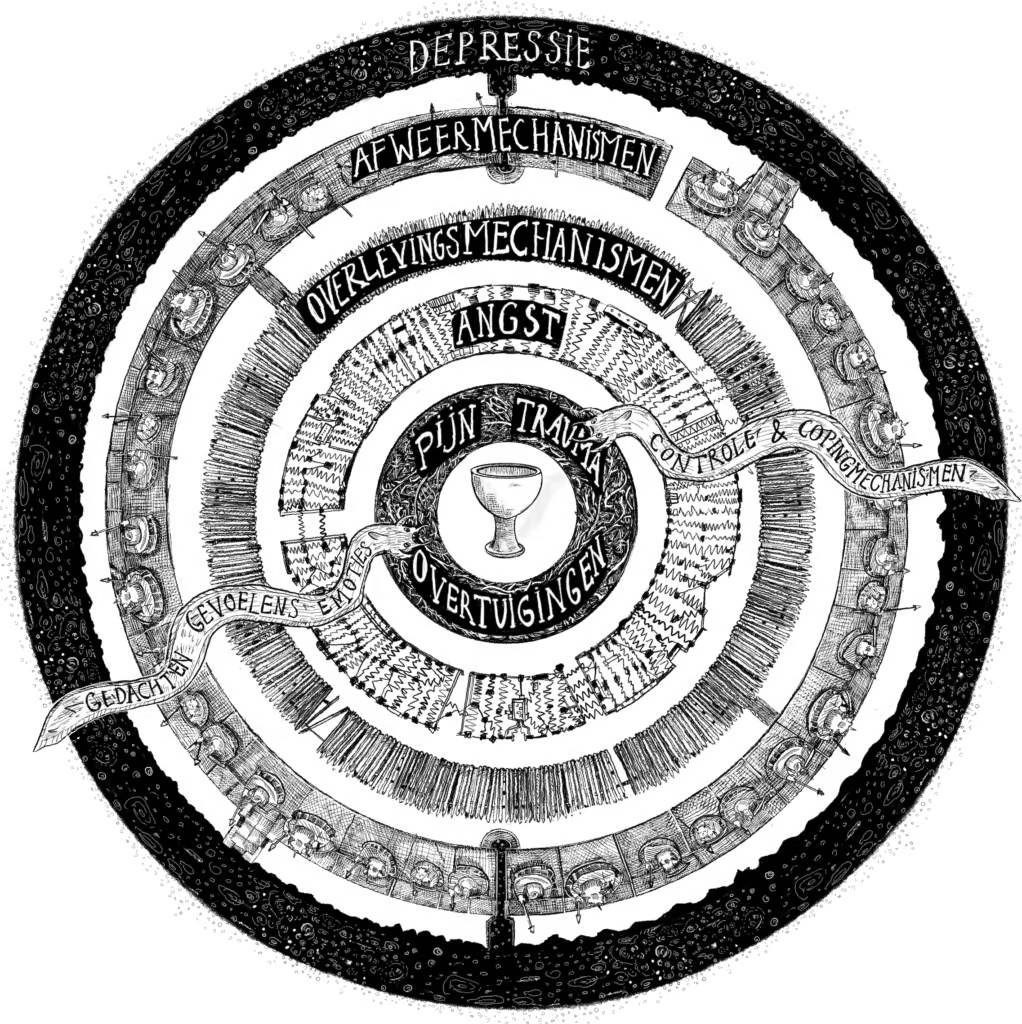
My reaction to loading the dishwasher is a prime example of“trying too hard.” In other words, trying to please others. When we use the defense mechanism of trying to please others, we often do so because we’re afraid the other person will reject us. As a result, we (consciously) try a little too hard.
“Pleasing is the conscious version of the unconscious survival mechanism known as flattery. It is a mechanism we use to ensure our own safety through flattery.”
For those of us who are interested, a survival mechanism is something you unconsciously activate from your brainstem—your primitive brain—to get yourself to safety in the blink of an eye. Whereas a defense mechanism is a conscious process originating in your prefrontal cortex—your thinking brain—to protect yourself from new pain.
So when you people-please, you’re consciously trying to avoid pain. Usually the pain of rejection. The other person has to find you likable, sweet, special, and kind. You can’t really do without the other person’s approval and attention. And so you go beyond your limits to be there for the other person: you start pleasing them.
Pleasing others, a shield against new pain
You can often tell when you’re going into overdrive. Something inside you leans too far forward, toward the other person. Many people who try to please others can even feel this physically in their bodies: they literally lean toward the other person.
Of course, this is perfectly fine if you just want to listen carefully to what someone is saying. Or if you want to comfort someone, standing by their side is really sweet. And if you just happen to be the caring type, that’s perfectly fine too.
But we lose our balance when we try to save the other person, mother them, or make sure they don’t reject or leave us. Then our caring behavior becomes a way to avoid our own pain and protect ourselves from new pain.
Stop trying to please everyone—how do you do that?
We can learn to stop trying to please others: for example, by accepting that we don’t know for sure whether the other person likes us, without bending over backward and going out of our way just to prove that we’re kind, fun, or special.
By allowing that uncertainty to exist, we create an honest situation: one in which the other person is completely free to choose whether they like us and want to connect with us.
We can often only do this once we feel secure within ourselves—for example, through healing work or by achieving stability in our lives. A sense of security is a prerequisite for growth and for exploring new things with curiosity, and this holds true once again.
SETTING BOUNDARIES AS A SOLUTION TO PLEASING OTHERS
When we allow ourselves to embrace the uncertainty of not knowing, the reward is that we become more less limited and more grounded in ourselves. The other person is allowed not to like certain parts of us; that doesn’t make us a bad person (nor does it make them one, for that matter).
It does make things more honest: our true selves come through more clearly. And usually , that reveals a very kind, caring, and special person. Someone who doesn’t always react or act perfectly, because this person is, after all, only human.
A FEW TIPS ON HOW TO STOP PLEASING OTHERS
- Choose when you want to be caring.
- Don’t push yourself too hard when caring for others.
- Don’t expect a “thank you.”
The dishwasher taught me an important lesson: “Rianne, there’s no point in pushing yourself beyond your limits or trying to please others by going above and beyond. Just try a little less hard, and in doing so, you’ll discover where your strengths lie—and where they don’t.”
Breaking the cycle of people-pleasing
“And learn what the other person’s strengths are, too.” Based on that insight, Siem now loads the dishwasher, and I have to say I’m actually totally fine with that ;). And he’s still into me, too! It’s been over 14 years now.
Do you want to stop trying so hard to please others and break free from that habit? Then take the online course: How Do I (Re)Establish Healthy Boundaries? In this course, we’ll delve much deeper into our people-pleasing behavior, and you’ll learn how to set healthy boundaries so that you don’t bend to others’ will but can live from a place of your own strength.
Does this article appeal to you? You might also want to check out the books by Discover Your Holy Grail. Are you curious about what we organize? Then sign up for one of our events. You might also want to check out our podcast for more inspiration.
My name is Rianne van Kuil, author of Discover Your Holy Grail – Your Hero’s Journey from Trauma to Healing, and a trauma and healing expert. I believe that complete healing from trauma is possible, and I guide people on that journey.
Photo: Istock – Mikhail Seleznev
Other articles
Even though we often don’t want to, we do it anyway: we go into survival mode.

→ Do your thoughts sometimes run away with you? → Do you want more peace of

→ Do you want to feel, but don’t know how? → Are you feeling all sorts

