Why is it so hard not to judge?

“Can’t I just do anything right the first time?”, “Why can’t I just act normal for once?”, “Oh, how stupid of me!”, “I’ve made such a huge mistake!”, “I never take action either—so nothing ever gets done, does it?”
REVIEWS
Verdict. We’re quite good at it. Toward others, certainly. But also—and perhaps especially—toward ourselves. Shall we start by distinguishing between JUDGING and EVALUATING? We evaluate all day long, both consciously and, above all, unconsciously, and that’s perfectly fine. We need our ability to assess in order to survive in the world: “Should I wait at the red light or just go ahead? There’s nothing coming, and I can see clearly around the curve… maybe I’ll just go ahead quickly?” Okay, it’s not allowed, but it is possible—we can usually judge that just fine. That changes immediately when we judge: ‘Oh no, I’m already halfway across the street and now that car is coming at me really fast. Why did I even try to run the red light? What an idiot I am for thinking I could “just make it” and that I was really paying attention… clearly not. Run!’
What exactly is a negative judgment?
“When we judge others or ourselves, we disapprove of what others or we ourselves do.”
And that’s what I want to talk about here. Because, why do we do that? Let’s take a look at some of the main reasons.
BELIEFS
As we grow up, we create mental blueprints of our experiences. Intense experiences leave a strong imprint right away, but most blueprints arise because we are conditioned: we go through the same experience over and over again, causing patterns to become ingrained. This also applies to patterns we call “beliefs.” These are negative beliefs about ourselves, others, and the world around us. There is a group of beliefs that is very strongly present in our brains: judgments. “I can’t do it,” “I’m worthless,” “I’m stupid,” “I can’t be trusted.” These beliefs usually arise in our childhood and are often instilled by parental figures (there they are again 😉 ). This is because, for example, they have the same negative judgments about themselves and (unconsciously) project them onto you. Or because they (unconsciously) impose these beliefs on you at every turn. The lack of compliments, kind words, or caring attention can also cause you to judge yourself. And it can also stem from older brothers or sisters who already know or can do more than you, causing you to constantly think that you can’t do something.
I myself had a father who “always knew better.” He couldn’t handle losing and was always picking fights with us—that’s how I remember it. He also thought my mother was very stupid, and a seven was a grade you got when you hadn’t tried your best. You get the picture: I felt stupid. Whenever I did something in my adult life that didn’t turn out well (and that happens quite often), I’d find myself thinking I was utterly stupid again, because that was the judgment I had formed about myself, one that was etched into me like a blueprint.
This went on until I realized that I’m not actually stupid, but actually pretty smart (see, for example, my LinkedIn post in response to Joris Luyendijk’s “The 7 Checkmarks”). Once I discovered that, I started believing something else: namely, that I’m actually pretty smart, and sometimes I do something clumsy or I can’t do everything. And that’s how it is.
LETTING GO OF WHAT OTHERS THINK
When we judge others, we reject ourselves. It has now become part of our national culture to do this (especially toward others): we often have strong opinions about others, or they have strong opinions about us. So we are confronted with negative judgments on a daily basis. But there is another way; we can let go of others’ opinions and examine our judgments by asking ourselves: ‘Is this actually true?’“Do I believe her opinion?” “Do I really think this when I say it about myself?” “Do I truly believe this, or has it unconsciously become part of my blueprint?” “And if I let go of this opinion and don’t believe it, what could I believe instead?” In this fairly simple way, we can transform judgments into positive beliefs about ourselves. This slightly boosts our self-esteem and reduces shame. In doing so, we let go of the judgment of others or of ourselves and detach ourselves from the opinions of others. Step by step, this has helped me look at myself with more love, patience, and gentleness. Now I see myself as a learner who’s actually pretty smart. And that’s a lot nicer than being a dumb box 😊.
A FEW TIPS FOR LETTING GO OF JUDGMENT:
- Ask yourself: Is this true? Do I really believe this?
- Next, ask yourself: Where does this belief come from? And do I want to let it go?
- Turn your judgment on its head and repeat this to yourself for 21 days.
Does this article appeal to you? Be sure to check out the books by Discover Your Holy Grail. Are you curious about what we organize? Then sign up for one of our events. You might also want to check out our podcast for more inspiration. Episode 59 is about our non-judgmental approach.
My name is Rianne van Kuil, author of *Discover Your Holy Grail – Your Journey from Trauma to Healing
, trauma and experiential expert, and podcast creator. I believe that complete healing from trauma is possible, and I guide people on that journey.
Photo credit: iStock fedrelena
Other articles
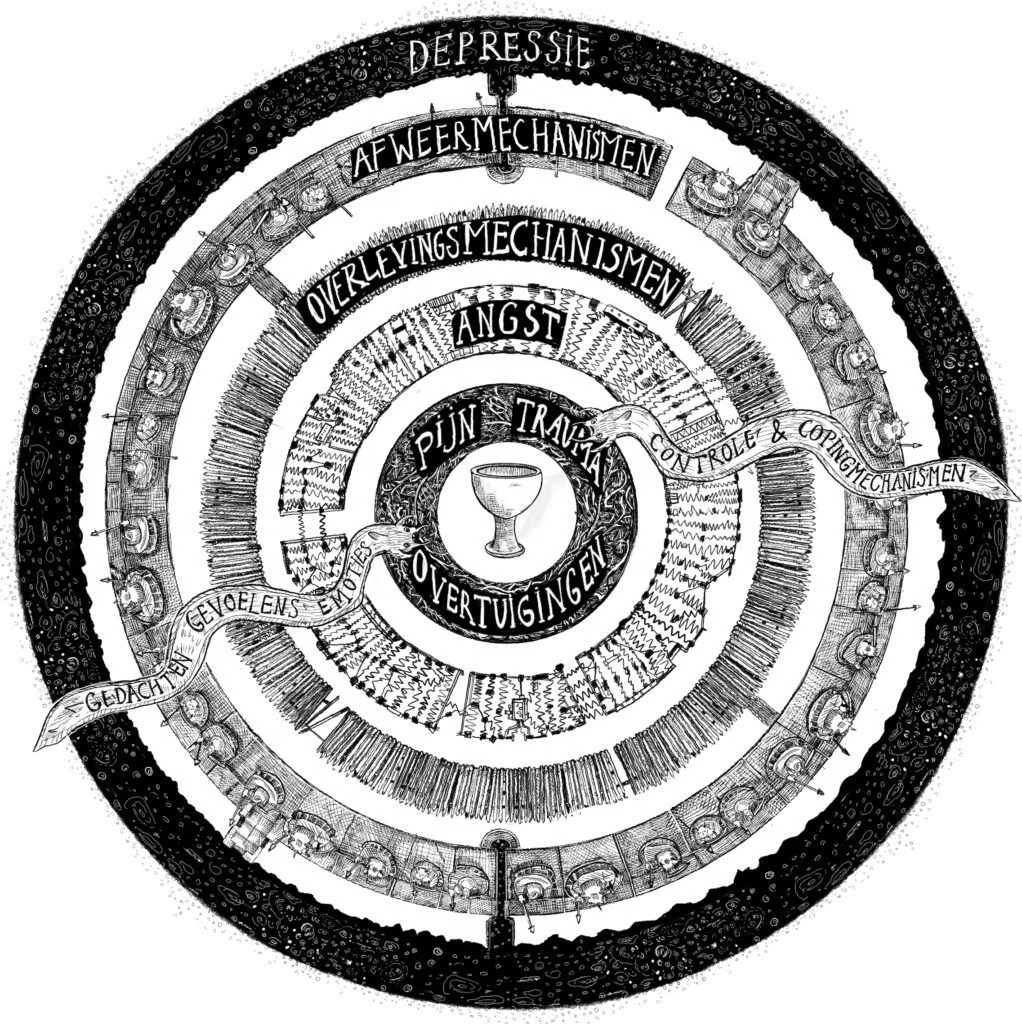
Even though we often don’t want to, we do it anyway: we go into survival mode.

→ Do your thoughts sometimes run away with you? → Do you want more peace of

→ Do you want to feel, but don’t know how? → Are you feeling all sorts

